
Algae Awareness for Muskegon Lake
July 15, 2026
The City of Muskegon is sharing information from Public Health Muskegon County and local environmental partners to help residents and visitors recognize and safely respond to algal blooms that may occur on Muskegon Lake during the summer months.
Recent monitoring has identified areas of algae growth in portions of the lake. While many algae are harmless, certain blooms can produce toxins that may affect people and pets. Conditions can vary significantly throughout the lake and may change from day to day.
What To Look For
Harmful algal blooms may appear as:
- Spilled paint
- Pea soup
- Floating scum
- Mats
- Streaks
- Clumps
- Sheens
Examples are shown on this Algae Awareness flyer.
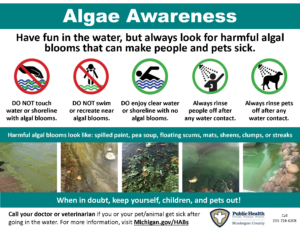
If You Encounter an Algal Bloom
If you see water that appears to contain an algal bloom:
- Do not swim or recreate in the affected area.
- Avoid touching the water or shoreline where blooms are present.
- Keep children and pets away from the water.
- Rinse people and pets thoroughly after any water contact.
Understanding Algal Blooms
Like bacteria levels, algal blooms are not evenly distributed throughout a lake. One shoreline may have visible algae while another area remains clear. Wind, currents, weather, and water conditions can all influence where blooms develop and how long they remain.
Monitoring conducted by local researchers has found that algae concentrations and toxin levels can vary between sampling locations, reinforcing the importance of avoiding areas where blooms are visible.
Staying Informed
The city will continue coordinating with Public Health Muskegon County, Grand Valley State University, and the Michigan Department of Environment, Great Lakes, and Energy (EGLE) to share updated information as it becomes available.
If you have questions about harmful algal blooms, visit the Michigan Harmful Algal Blooms website or contact Public Health Muskegon County. Additionally you can read through this FAQ on harmful algal blooms from the Michigan Department of Health and Suman Services (MDHHS).