
The Highway Department is responsible for 200 miles of road, 525 alleys, 3,164 streetlights, and 22,000 traffic signs in the City. Please use the resources provided to the left and contact us with any other needs or requests.
City of Muskegon 2022 Transportation Asset Management Plan
Snow Plowing Routes
The city’s snow plan focuses on keeping traffic moving and especially makes sure our first responders can assist the public.
Your local taxes are helping to provide the necessary snow removal equipment to clean 195 miles of local roads. Last season, the city spent about $750,000 on plowing operations—roughly $19 per resident.
City crews are working around the clock and need plenty of room to operate. The trucks travel slowly to plow the most snow possible and they have difficulty seeing motorists due to blind spots. So please give them enough room to plow.
Please know the city clears roads in this order:
- Priority One routes— major roads that provide access to emergency services (police/fire stations, hospitals, etc.) are treated first. All efforts will be made to keep them open and maintained, which often means running the routes repeatedly to ensure they remain passable. Priority One Route Street Examples: Sherman Blvd, Getty St, Seaway Drive
- Priority Two routes— roads that allow access to schools, nursing homes, city recreation facilities, and neighborhoods are plowed second. Based on a storm’s severity, these routes will be kept open and maintained, if possible, during a snowstorm. Priority Two Route Street Examples: Barclay, Wood, and McCracken
- Priority Three routes—neighborhood streets that connect to more active roadways located in less populated areas of the city and are plowed as resources allow, but only after the Priority One and Two routes are clear. The city is broken into seven districts and each sector has a crew that goes out at the same time. Each district takes a minimum of six to eight hours to completely clear the roads of snow. Priority Three Route Street Examples: Austin St, Ridge Ave, and Hamilton Ave
Snow Plowing and Ice FAQ
🎯 What is the city of Muskegon’s snow and ice management goal?
To clear and de-ice as close to bare pavement as possible, all major, local, and trunk-line roads within 24 hours of a winter event.
🛣️ How are city roads prioritized?
Snow and ice management is categorized into three priorities:
1. Trunk-lines
9 miles of major trunk-line roads
M-46 (Apple Ave)
B-31 (Seaway Drive)
2. Major Streets
72 miles of road
East, West, Center, and Downtown
Hospital routes, emergency services.
3. Local Streets
114+ miles of road
7 districts
525 usable alleys
❄️ Who gets plowed first after a snow or ice event? Major streets are the priority for snow plowing and salting; emergency access for hospital, fire, and police routes are part of each major street plan. Local streets are plowed after all major streets have been cleared and salted.
🌨️ Why does it seem like my residential road is last to be plowed? The city of Muskegon is committed to the highest standards of service for its residents. Each of the 7 districts is assigned one to two trucks after a snow event. Each district takes a minimum of six to eight hours to completely clear the roads of snow. New storms will often require the city to re-assign drivers working in districts back to the major roads. If a citizen feels their road was missed, they should call to report the issue with the Department of Public Services at 231-724-4100.
☃️ Why do city plow trucks put all the snow from the road in my driveway? Plow truck operators are tasked to clear all the snow from the road towards the curbs. Plow trucks typically operate in tandem, using various plows to push as much snow as possible from the center of the road to the curb lane. The trucks are not designed to allow for where or how the snow ends up, just that it’s off the road deck and pushed to the sides.
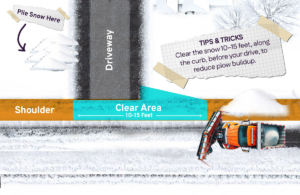
🥶 Can the city plow the snow out of my driveway they left behind? Clearing snow from the thousands of private driveways in the city of Muskegon after any snow event would be an insurmountable task, and the potential to damage private property with heavy equipment would leave the city open to costly legal claims. Clear a path of snow 10-15 feet parallel from the curb-lane before a drive approach to minimize the amount of snow left by plow truck.
🧊 Why doesn’t the operator keep the blade straight to push the snow forward instead of to the side? The snow will spill off the blade onto both sides of the truck, leaving a mess in the middle of the road and curb-lane. Under certain conditions, enough snow buildup beneath the truck’s undercarriage could force it to a physical stop where it would become stranded in the road.
😅 Can residents put the snow left in driveways back into the street? Snow should be shoveled to the side of a resident’s driveway and not returned to the street. Placing snow back into the public right-of-way is a violation of city ordinance and subject to citation by the Muskegon Police Department.
🧂 Why doesn’t the city put salt down on residential roads? The city uses salt and chloride to de-ice roads where traffic volume is heavy enough to maximize its effectiveness by carrying the materials along the road deck. Rock salt will melt snow and ice between the temperatures of 18° and 30° degrees, but its effectiveness decreases drastically the lower the temperature falls below 15° degrees Fahrenheit. Road salt and chloride mixtures have almost no effect below 10° degrees. De-icing materials are not typically applied to local streets where traffic volumes are low. Some intersection may be salted, as determined by the Streets Supervisor, or when requested by the police or fire departments.
🌨️ Who is responsible for clearing the sidewalk in front of my residence? Property owners are responsible for clearing the pedestrian sidewalks along their property lines.
🤔 Why does the city clear some sidewalks, but not mine? The city may clear designated school route sidewalks or other sidewalks under unique circumstances, such as bridges and over-passes. The city is under contract to clear sidewalks for the downtown business assessment.
☃️ Why do the plow trucks throw snow from the road onto my sidewalk? City plow trucks typically operate between 12-15 miles per hour while plowing local streets. Certain conditions may require more speed to push the existing snow over the banks, which may unintentionally fall onto the sidewalk.
🚚 Why do the drivers run down my street so fast? It may appear that city plow trucks are moving incredibly fast, but such observations are often relative to the size of the trucks and the task they are performing which may make it seem like they are moving much faster than they are in real-time. If a citizen feels a plow truck is operating at unsafe speeds, the observer should note the time and street address, and contact the Department of Public Works at 231-724-4100.
⏳ If I live on an alley and park in the back, when should I expect my alley to get plowed? Alleys are typically plowed 24-hours after a snow event with 4-wheel drive utility trucks. The sheer number of alleys in the city of Muskegon make it a time-consuming task to complete, and the severity of storms can affect the time required to plow through them all.