
Water System
The City of Muskegon Water Filtration Plant treats water from Lake Michigan to produce abundant, clean, and safe drinking water. The plant operates 24 hours a day, seven days a week, with staff onsite to routinely sample and analyze the water as it is being treated.
 The over 4 billion gallons of drinking water produced at the plant every year serves a population of about 90,000 in the City of Muskegon and several neighboring communities, including: Dalton Township, Fruitland Township, Fruitport Township, Laketon Township, Muskegon Township, the City of North Muskegon, the City of Norton Shores, and the City of Roosevelt Park. Within these communities, the water produced, at a capacity of 40 million gallons every day, is used at residential, commercial, and industrial locations, in addition to supplying water to fire hydrants.
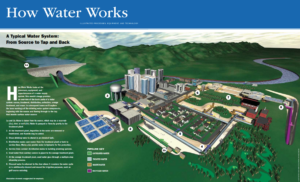
How Water Works
Water Quality Report
The annual Water Quality Report, which describes the source and quality of the drinking water provided in the City of Muskegon, is available below.
View the Water Quality Reports
Legacy
The City of Muskegon’s water system dates back to 1874 with the construction of a pump station and reservoir at Eighth St. and Houston St. While the plant is well maintained and modern, some of the infrastructure constructed in the 1920s is still used in the treatment process today, nearly 100 years later.
Water Sources
Our water source is Lake Michigan. The Great Lakes provide some of the best quality water when compared to other surface water sources, such as rivers and inland lakes.
Water Treatment
The Water Filtration Plant has a treatment capacity of 40 million gallons per day (mgd). This equates to 27,778 gallons per minute, or enough water to fill eight average-sized bathtubs every second.
Additional Treatments
Muskegon played an important role in the early studies of fluoridation of municipal drinking water.
Microbiology Laboratory
The Water Filtration Plant laboratory is state-certified, allowing us to perform certain sample analysis that are required by drinking water regulations.
Water Quality Monitoring at the Plant
Our operators are constantly monitoring the water quality by performing a variety of water quality tests on samples from nine different points throughout the water treatment process.
Water Quality Monitoring in the Distribution System
The infrastructure throughout our service area used to deliver water to consumers is referred to as the distribution system.
Additional Water Monitoring
Check out the city’s annual water quality report based on frequent sampling.
Electrical Power & Generators
Learn about the city’s systems to protect the constant supply of water.
Capital Improvement Projects
Our facilities require continual investment to maintain the level of service demanded by regulations and our customers. Here are some of the improvements we’ve made over the last decade.
Frequently Asked Questions
-
In 2018, MDEQ contracted AECOM to do sampling and testing for PFAS throughout the state. The concentrations of PFOA and PFOS in our water were 2 ppt, and that is well below the U.S. Environmental Protection Agency’s (EPA) lifetime health advisory (LHA) of 70 ppt.
-
The City of Muskegon has conducted all required monitoring and sampling since the Lead and Copper Rule was promulgated. Sampling results over the years have met the standard and never exceeded levels requiring any action. As the recent water quality report indicates, our 90th percentile lead levels are at 3 ppb (parts per billion), well below the action level of 15 ppb.
For information about lead in drinking water or how the situation in Flint is related to what we do here in Muskegon, contact Joe Buthker , Muskegon Water Filtration Plant Superintendent at (231) 724-4106 or [email protected].
-
Chlorine is added in small amounts to drinking water. It is the disinfectant applied to destroy pathogenic (harmful) bacteria and microbes. This keeps the water safe to drink.
-
The milky-white appearance is from tiny air bubbles in the water similar to gas bubbles in beer or soda pop. After a little while, the bubbles rise to the top and are gone. This occurs most often in the winter when drinking water is cold.
-
The Water Filtration Plant uses Lake Michigan as a source of supply.
-
For water quality questions or complaints, please contact (231) 724-4106. It is likely a representative will be sent to your home to help you or to explain what is causing the problem. Often, a chlorine residual test is performed or a bacteriological sample is collected for analysis.
-
For water pressure issues or other service problems, please contact (231) 724-4100. It is likely a representative will be sent to your home to help you or to explain what is causing the problem. If required, a cross connection inspection will be performed, depending on the nature of the problem.
-
Give the plant a call at (231) 724-4106, and we’ll be happy to get a tour set up.
-
No, our drinking water does not contain any of these.
-
For any questions about your City of Muskegon water bill, please contact Water/Sewer Billing at 231-724-6718.
-
To view or pay City of Muskegon water bills online, please click here.
-
Chlorine is added to the drinking water to destroy disease-causing organisms and is a critical part of making drinking water safe for consumption. The Water Filtration Plant is required to add sufficient chlorine to the water so that a small amount remains in the water once it leaves the Water Filtration Plant. Odors caused by chlorine are often described as smelling like bleach or a swimming pool. These odors can fluctuate in intensity as the chemistry and biology of the water from Lake Michigan goes through seasonal changes. Our staff monitors the chlorine levels at the Water Filtration Plant continuously and around the city weekly to ensure chlorine levels remain within the proper range.
-
Earthy, musty, fishy, or moldy odors are typically caused by algae blooms in Lake Michigan. Summer and fall are the most likely times for the lake to experience algae blooms, and this is when these odors will be most noticeable. As Lake Michigan goes through seasonal changes, the chemistry and biology of the water can change in ways that cause these odors to develop, but it does not indicate that the water is unsafe for consumption.
-
Many water mains are iron pipe, and it is typical for iron sediment to accumulate and settle in the bottom of these water mains. Large changes in water flow can cause this iron sediment to resuspend in the water and become noticeable at your tap. Large changes in flow can be caused by water main breaks and repairs, nearby construction activity, seasonal water flushing, firefighting, and anything else that disrupts the normal flow through the water main. Although iron discoloring the water appears unappetizing and may impart a metallic or bitter taste, it is not a health threat.
Generally, if you wait for a short period of time (an hour) and flush your faucet for 10 minutes, the discoloration will disappear. If you are noticing this discoloration only in your hot water, it could be sediment from your water heater, and you can contact a licensed plumber to help evaluate your water heater.
-
If low water pressure is only affecting a part of your home or a single faucet, it is likely a blockage in your pipes or fixtures. You can try cleaning your aerator, and if that does not help, contact a licensed plumber. If you are experiencing low pressure throughout your entire residence, please contact the Department of Public Works at 231-724-4100.
-
The City of Muskegon has regularly collected drinking water samples from customers’ taps to test for lead since 1992. No lead has ever been detected in the drinking water as it leaves the Water Filtration Plant, yet not all of the samples collected at consumers’ taps are lead-free. So how does lead enter the drinking water? A common source of lead in drinking water is internal plumbing with lead-containing fixtures, faucets, and solders. Another potential source of lead in drinking water is lead service lines. A service line is the pipe that connects the water main to a building’s internal plumbing. In Muskegon, most service lines are made of a galvanized pipe connected to a water main using a very short section of lead pipe referred to as a lead gooseneck. In order to ensure testing captures lead from either source, the State of Michigan began requiring two one-liter samples be collected for lead testing. The 1st liter is collected immediately as the faucet is opened, and this sample likely represents water in the building’s internal plumbing. The next sample collected is the 5th liter of water, and this water better represents water in contact with the service line.
The drinking water we regularly test as part of our lead sampling program is limited to locations on our state-approved sampling plan; we are unable to test your drinking water for lead upon request. If you are interested in having your drinking water tested for lead, a drinking water laboratory will be able to provide this service for a fee. If you need help locating a drinking water laboratory, please contact the Water Filtration Plant at 231-724-4106.
-
The City of Muskegon has never exceeded the action level for lead in drinking water. The 90th percentile value is used to determine compliance with drinking water regulations and must not exceed the action level of 15 parts per billion (ppb) for lead. The City of Muskegon’s 90th percentile value for lead is 5 ppb, or put another way, 90% of the locations tested for lead were at or below 5 ppb. All samples tested for lead were collected from locations with a lead gooseneck, and it is important to note that a service line with a lead gooseneck does not guarantee lead will be present in the drinking water. Of all the 5th liter samples collected that likely represent water in contact with the service line and lead gooseneck, 73% had no level of lead detected and 97% were below the lead action level.
Most importantly, the City of Muskegon is working to replace all lead service lines, thereby removing all lead goosenecks from the water system. This is a labor-intensive, expensive, and time-consuming task, but when complete, the City will have no more lead service lines. Removal of all lead service lines from the water system is a critical part of achieving a lead-free water system.
-
The Michigan Lead Safe website contains information about lead.
Results from the City of Muskegon’s lead sampling are reported in our annual water quality report. This report contains additional information about lead in drinking water and reports on the progress of lead service line replacement in the City of Muskegon.
The City of Muskegon Water System Advisory Council meets annually to provide updates on lead in drinking water. Meetings are open to the public, and meeting dates will be publicly posted.
-
If your question is not answered above, or if you have further concerns you would like to discuss, please contact the staff at the Water Filtration Plant at 231-724-4106. If you call with a water quality concern, we will likely ask you some of the following questions to help troubleshoot your problem:
• How long have you noticed the problem? Does the problem occur all the time or periodically?
• Does the problem occur at all inside taps or just some?
• Does the problem occur only when you first turn on the water or does it occur continuously?
• Does the issue occur with cold water, hot water, or both?
• Have you had any recent work done on your water plumbing or faucets?
• Have you noticed any work crews or fire engines in the area?If we cannot address your concern over the phone, it is likely we will send a team of operators to investigate. The team will perform a cross connection inspection, measure the chlorine level in the water, and collect a sample for bacteriological analysis (Total Coliform and E. coli).
If you desire testing beyond the chlorine and bacteriological analysis performed by the City of Muskegon Water Filtration Plant, a drinking water laboratory will be able to provide this service for a fee. If you need help locating a drinking water laboratory, please contact the Water Filtration Plant at 231-724-4106.